
The State’s Case Against Fonny
If Beale Street Could TalkThis thread traces how a weak rape accusation becomes a state-backed prosecution that keeps Fonny imprisoned despite mounting doubts about its evidence.
increasing Bearing strength in each event
 decreasing
Bearing strength in each eventdecreasingThe March Accusation

The Accusation Takes Shape
A charge without certainty
On the night of March 5, Victoria Rogers reports that she was raped in the vestibule of her home. The accusation later identifies Fonny as the assailant, although the assault occurred in darkness and the two had never met before the police investigation. The case begins with Victoria’s testimony, but its certainty is already inseparable from the conditions under which she is asked to identify a stranger.
Distance and contradiction
The alleged crime takes place on Orchard Street, far from Fonny’s home on Bank Street. Officer Bell claims to have seen Fonny run from the scene, although his beat is on the West Side. Those geographical and procedural contradictions do not prevent the accusation from becoming an arrest and a prosecution. Instead, they foreshadow the imbalance that will define the case: the state’s story is accepted first, while Fonny must somehow pay to disprove it.
An Arrest at Home

The Arrest at the Door
A household interrupted
On the night officers come for Fonny, Daniel Carty is at the Bank Street room, still shaken by the account of his own imprisonment. The visitors’ arrival turns a private evening of friendship and care into an abrupt confrontation with the police. Fonny is taken from the people who know him best, while the accusation supplies the authorities with a ready-made explanation for his removal.
From suspicion to confinement
The arrest does not resolve the contradictions in the case; it gives them the force of custody. Fonny is placed behind bars before he can establish the truth of what happened, and the Rivers family must respond from outside the jail. His absence becomes a daily fact, while the state’s allegation begins to shape how every witness, lawyer, and relative is treated. The prosecution’s power lies not only in its claim, but in its ability to make that claim determine Fonny’s life before trial.
The Case Turns Against Itself

A Defense Under Pressure
Missing testimony
Arnold Hayward tells Tish and Sharon that Victoria Rogers has disappeared with her husband, leaving the defense without access to the prosecution’s principal witness. Finding her will require investigators and money the family can barely afford. Her absence does not immediately weaken the state’s position: Hayward warns that prosecutors can present her as a traumatized woman whose behavior is understandable, even when the defense sees disappearance as cause for suspicion.
Witnesses held at a disadvantage
The defense also struggles to reach Daniel Carty, whom the District Attorney’s Office has arrested and is holding incommunicado. Hayward believes officials may be trying to pressure him to change his account. Meanwhile, Officer Bell remains the prosecution’s authoritative witness, asserting that he saw Fonny flee. The case’s imbalance grows plain: the people who might challenge the state are missing, detained, or treated as unreliable, while Bell’s contested account retains institutional weight.
A Witness Beyond Reach

The Prosecution Loses Its Witness
An attempted appeal
Sharon travels to Puerto Rico to find Victoria Rogers and asks Pietro Alvarez to help her reopen the identification. In a nightclub and later in a crowded settlement, she tries to distinguish the possibility of a mistaken identification from the reality of Victoria’s suffering. Victoria recognizes Fonny’s face in the photograph but insists that the assailant was not laughing as Fonny appears to be. Sharon’s appeal exposes the limits of what either woman can know from the available evidence.
A sudden collapse in the case
Victoria breaks down and is carried away after suffering a miscarriage; she is taken toward Barranguitas, and Sharon learns that she cannot be brought back to New York. The trial is postponed because the state’s principal witness is unavailable. This development damages the prosecution’s immediate timetable, but it does not free Fonny: officials seek delay, and the family must prepare to fight for bail while Daniel remains beyond their reach. The case loses its central witness without delivering the exoneration the family needs.
Delay Becomes Its Own Sentence
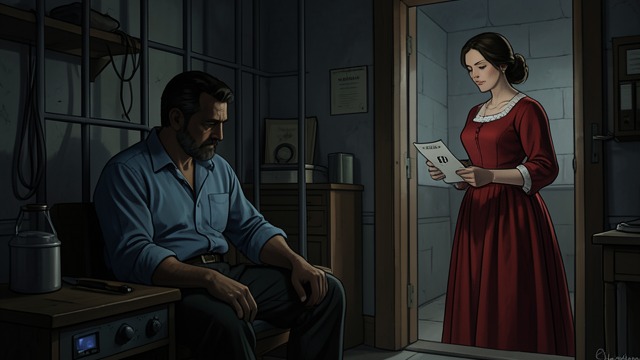
Waiting Behind Bars
The calendar as an adversary
With the trial postponed, time becomes an active part of the prosecution’s pressure. Fonny waits in jail while the family continues to seek a hearing and considers bail. Hayward can pursue legal steps, but the state controls the pace and can keep the case alive without producing a prompt resolution. For Fonny, each postponement means another stretch of life lived apart from Tish and their expected child.
Hope without release
Tish visits whenever she can, and the family scrambles to raise the money for bail. Fonny, bruised and increasingly changed by confinement, tells her that he is still coming home; his determination sustains her, but it cannot substitute for a court decision. The novel closes without a verdict or confirmed release. The central conflict therefore remains unresolved: the family’s love and effort resist the state’s delay, yet the machinery of prosecution still holds Fonny’s future in suspension.
March 5, before the novel’s opening
March, after Daniel’s evening visit to Bank Street
After Tish tells Arnold Hayward that Victoria Rogers has disappeared
After Sharon returns from Puerto Rico
Summer, after the trial is postponed and bail is pursued
